
This article explains the enhancements coming to budgets in Lookout, why we've made them, and what they mean for you. It's here to help you feel confident and prepared before you turn the new experience on.
This update won't switch on automatically. The budget enhancements are enabled by your organisation through the Release Hub, when you're ready. Nothing changes in your instance until you choose to turn it on, so there's no rush. Take the time to read through our articles and guides, attend a Q&A webinar, and get comfortable with the changes before enabling them.
Want the how-to? This article covers what's changing and why. For step-by-step guidance, see Budgets: an overview and Creating and managing budgets.
Why we've made these changes
Support at Home is complex, and we've listened closely to your feedback over the first year of the program. A lot of that feedback came down to one thing: making it easier to understand and stay on top of a Member's funding.
Budgets aren't just "how much money is left today." Under Support at Home, it's about balancing multiple funding sources, how each can be used, amounts rolling over, and which direction spending is trending. Utilisation is critical under Support at Home, so it's just as important to identify under-utilisation as over-spending, helping you have timely, informed conversations with Members before small issues become big ones.
These improvements are all about giving you more clarity, sooner - so you can see what's happening, understand why, and act in time.
What’s changing
Planning and live tracking are now separate
Previously, budget planning and tracking sat together on one screen, which could make it difficult to distinguish the agreed plan from actual and projected spending. They're now separated into three distinct tabs:
- Live & projected balance tracking: How the Member’s funding is being utilised, and where their balance is projected to finish at the end of the period.
- Budget plan vs spend: How the agreed budget plan is tracking against actual spend, so you can see where spending is tracking over or under the plan.
- Budget planning: The point-in-time plan agreed with the Member.
This makes it clear at a glance whether you're looking at the agreed plan, actual spend or projected balances.
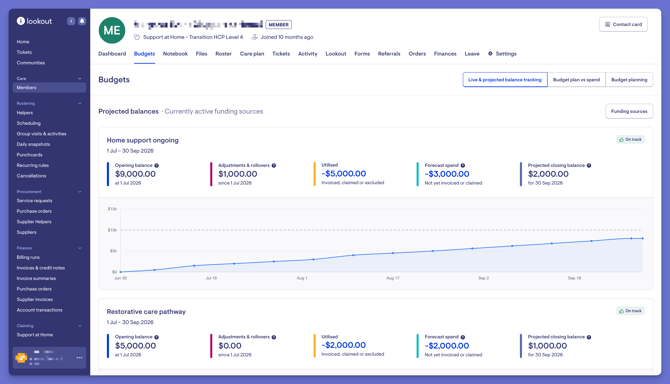
A clearer view of live & projected balance tracking
The live tracking view has been redesigned to make funding easier to follow:
- A spend-over-time chart that shows how spending is tracking, and when a Member may move into overspend.
- Funding sources broken out into their own panels (for example, ongoing, restorative care, assistive technology, and home modifications), rather than combined into one balance.
- A projected balance showing the Member’s expected position at the end of the period.
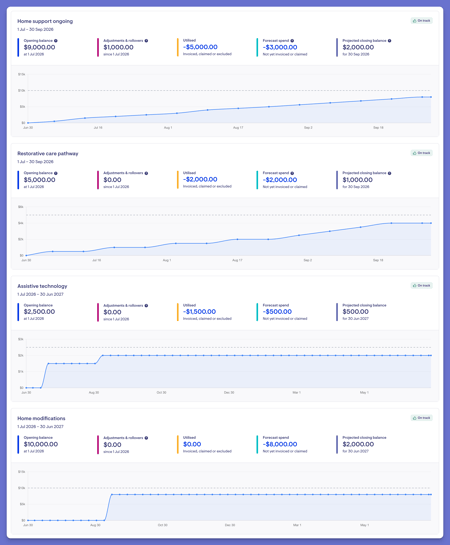
A stable transparent opening balance
Opening balance information is sourced from Services Australia (SA). Previously, if SA made changes, such as to rollover or adjustment amounts, the opening balance in Lookout would shift. This was a common source of confusion, as it could be difficult to understand what had changed and why.
Now, the opening balance is held as a stable starting position, with subsequent rollovers and adjustments shown separately and clearly dated, so you can see when and why the balance has changed

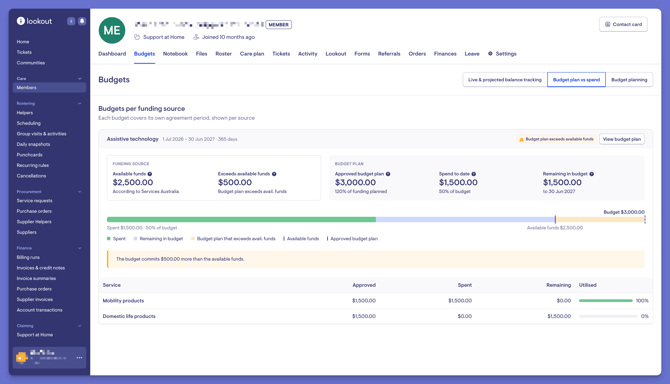
Seeing how the plan compares to actual spend
The new Budget plan vs spend tab compares the agreed budget plan against what’s actually been spent, so you can see at a glance where spending is tracking over or under the plan, and where the plan exceeds the funding available.
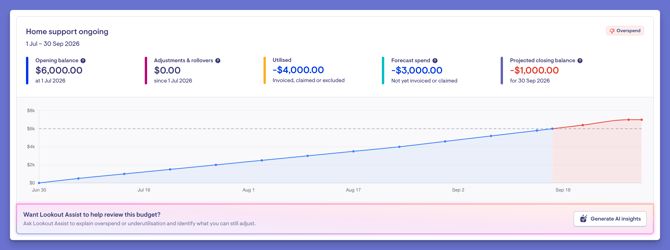
Introducing the Lookout Assist Funding Analyser
The new Funding Analyser, powered by Lookout Assist, helps you understand what's happening in a Member's Support at Home budget. Rather than working through the budget yourself to identify what's driving a change, Lookout Assist can analyse it and explain what's happening in plain English.
Funding insights are specific to the funding source they relate to, helping you identify where funding may be over or under-utilised and where to look for more detail.
To learn more, please view our dedicated article – Budgets with Lookout Assist: Funding Analyser.
Improvements to creating budgets
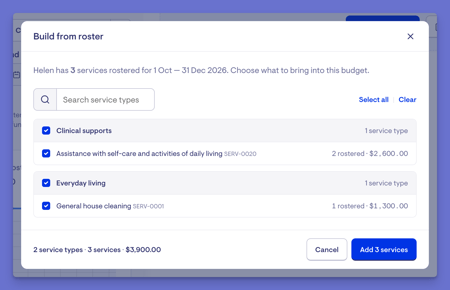
Creating a budget from a Member's roster is now more accurate, including weekend and variant rates for Support at Home. You can also select which roster items to include before generating the budget.
For bulk budget generation, you can choose the budget type and generate budgets for a future period. Generated budgets will also flag potential issues, such as an empty plan or planned spending exceeding the available funding, so you can review them before finalising or sending the budget.
Budget warnings
Each time a budget is saved or generated, Lookout checks whether the planned services align with the Member’s available income and funding. If they don’t, a warning appears:
- As a banner at the top of the budget.
- As an Error tag in the Member’s budget list.
- Under Funding and budget risks on the dashboard, in the Budget plan count.
- In the Budget plan insights filter on the Members list.
A budget with an open warning can’t be approved or shared with the Member (for signing or without a signature) until the warning is fixed or dismissed.
The same applies to bulk generated budgets. When bulk generating budgets with the option to make them live immediately, budgets with warnings are still created but remain in draft with an error. The Member is listed as failed in the notification you received once the job has been completed and will notify you if there's any error.
To resolve a budget warning, open the budget and either:
- Adjust the service plan to address the warning (e.g. add more services to improve utilisation or reduce services if the budget exceeds available funding), then select Save.
- Or dismiss the warning and provide a reason for doing so.
Once the warning is resolved or dismissed, you can approve and share the budget.
If an already approved budget develops a warning after editing, it remains approved but can’t be shared again until the warning is resolved or dismissed.
Types of budget warnings
1. Empty service plan
-
Message: This Member’s budget has an empty service plan.
-
What it means: No services are planned, so none of the Member’s funding is allocated.
Common causes:
- No visits or services are scheduled on the Member’s roster during the budget period.
- Rostered services aren’t fundable under the Member’s Support at Home classification.
How to fix:
- Check the Member’s roster for scheduled visits, purchase orders or services during the budget period.
- Add services using Build from roster or manually in the budget.
- Save the budget.
If the empty plan is intentional, dismiss the warning.
2. Over allocated
Message: Budget exceeds the calculated income by $X.
What it means: Planned services exceed 100% of the Member’s available income and funding.
A budget may also show that no income has been recorded. This can happen when a budget is generated before Services Australia publishes the Member’s funding for that period.
How to fix:
- Reduce planned services to fit the available funding.
- If income is missing or incorrect, check the Member’s funding details and update the budget income.
- Save the budget.
If other arrangements cover the difference, dismiss the warning.
3. Under allocated
Message: Budget has low funds utilisation (X%).
What it means: Planned services use less than 80% of the Member’s available funding.
How to fix:
- Add the services the Member is receiving or plan additional services to use the remaining funds.
- Save the budget.
If leaving funds unused is intentional, dismiss the warning.
Healthy range: Budgets with utilisation between 80% and 100% of available funding don’t generate a warning. These are the same thresholds used in real-time tracking.
Dismissing a warningIf the budget is correct as it is, select Dismiss on the warning banner and add a note explaining why. The budget can then be approved and shared.
Things to know
- Warnings update on save: After fixing a budget, save it to trigger another check. The warning clears if the budget is now within range.
- Dismissed warnings stay dismissed: A dismissed warning won’t return for the same issue if the budget is edited. However, a new warning will appear if the budget develops a different issue (for example, becoming over allocated or having an empty service plan).
- Generic warning messages: Messages such as “Budget exceeds available funding” or “Budget below available funding” without an amount indicate the budget figures have changed since the warning was raised. Save the budget to recheck it.
What this means for you
- Nothing changes until you enable it. You're in control of the timing via the Release Hub.
- The information you rely on is presented more clearly. The enhancements change how budget information is organised and displayed, without changing the Member's underlying funding arrangements. It's worth preparing your team. Because planning and tracking now sit in separate tabs, and the live tracking view looks different, it's a good idea to make sure your care partners, finance and rostering teams know what to expect before enabling the enhancements.
Lookout Assist required. The Funding Analyser is only available if your organisation has Lookout Assist switched on, and it specifically requires the new master services agreement (MSA). If you don't see the option to review a budget with Lookout Assist, your account either doesn't have Lookout Assist enabled or isn't on the required agreement. Speak to your Lookout contact to enable it.
How to prepare
- Read the articles - Budgets: An overview and Creating and managing budgets walk through the new experience.
- Rewatch our webinars and read the FAQs - See our October 2026: Budgets enhancements FAQs for links to all of our webinars, including our Q&A sessions. We've also compiled the questions asked in the article for you, for quick reading.
- Plan your rollout - decide who needs to know what, and consider how you’ll help your team become familiar with the new budget experience before enabling it organisation-wide. For a step-by-step approach and a readiness checklist to work through first, see our Adopting the budget enhancements: a rollout guide.
- Enable when ready - turn on the budget enhancements via the Release Hub when your team is prepared.
Still have a question? Take a look at our Budgets: FAQ and our October 2026: Budgets Enhancements FAQs where we answer the most common questions in one place.
Still need help?
If you're still experiencing issues or have questions about the changes, please contact our Support Team and include:
- The specific area or change you have a question about
- Screenshots (if possible)
- Any error messages received