
This guide explains how to update Visit rates from Settings, how the rate change review screen controls which a change applies to and from when, how to force a change through when you're only adjusting contract dates, and how to avoid accidentally applying a new rate to work that was delivered at the old one. In Lookout, rates fall into three types:
This guide focuses on Visit rates, which determine the product used for services delivered during a scheduled visit.
Before You Start
To follow this guide, make sure:
- You have an access role that includes the "Configure visit rates" permission. Without it, the Visit rates area won't be available to you.
- Your current billing period is finished and closed off before you change any rates. This is the single most important step - see the warning below for why it matters so much.
Important: Close off your billing before updating rates
When you update a rate, the new rate becomes the "current" rate immediately. Anything that recalculates its price after the update can pick up the new rate - even if the service was delivered earlier at the old rate. This particularly affects purchase orders and care management tracked time:
-
Open purchase orders from an earlier period will move to the new rate if they're touched after the update. For example, when a supplier invoice is matched to them, or a line is edited -even if the line itself wasn't changed. You may also see the old rate on the purchase order overview, but the new rate once you open the individual line.
-
Care management time that's been logged but not yet included in a billing run will pick up the new rate rather than the rate that applied when the work was done.
To stay in control of which rate applies:
- Where possible, align rate changes with the start or end of a billing period, not mid-period.
- Complete and close off all billing for the current period first. Finish open purchase orders, match supplier invoices, and finalise the relevant billing runs and invoices.
- Only update your rates once that period is fully closed.
This way, everything from the earlier period is locked in at the old rate before the new rate takes effect.
Step-by-step instructions
Step 1: Navigate to Visit rate settings
- From your home dashboard, navigate to the overflow menu by clicking your name or the ellipsis (...) next to your name in the bottom left-hand corner.
- The overflow menu will open - click Settings.
- In the main settings, navigate to the Rates section, then click Visit rates.
- This will load your uncategorised rates by default. For funding-specific rates, find them listed under Visit rates, then click to surface. For example, click CHSP to display all of your configured CHSP rates.
-
You'll see tabs for Active and Archived rates, and an option to add a New Rate.
Step 2: Update your rate
-
If you want to update an active rate, be sure you are in the Active tab. The same goes for if you want to update an archived rate - click the Archived tab first.
-
You can search for rates by name - for example, searching for NDIS rates when new pricing comes into effect lets you focus on just the rates that need updating.
- Find the rate you want to change, then scroll the screen to the right to view more of the rates details.
- When you reach the end of the scroll, click the ellipsis (...) next to the Quantity Type column.
- A short options menu will appear. Click Edit.
-
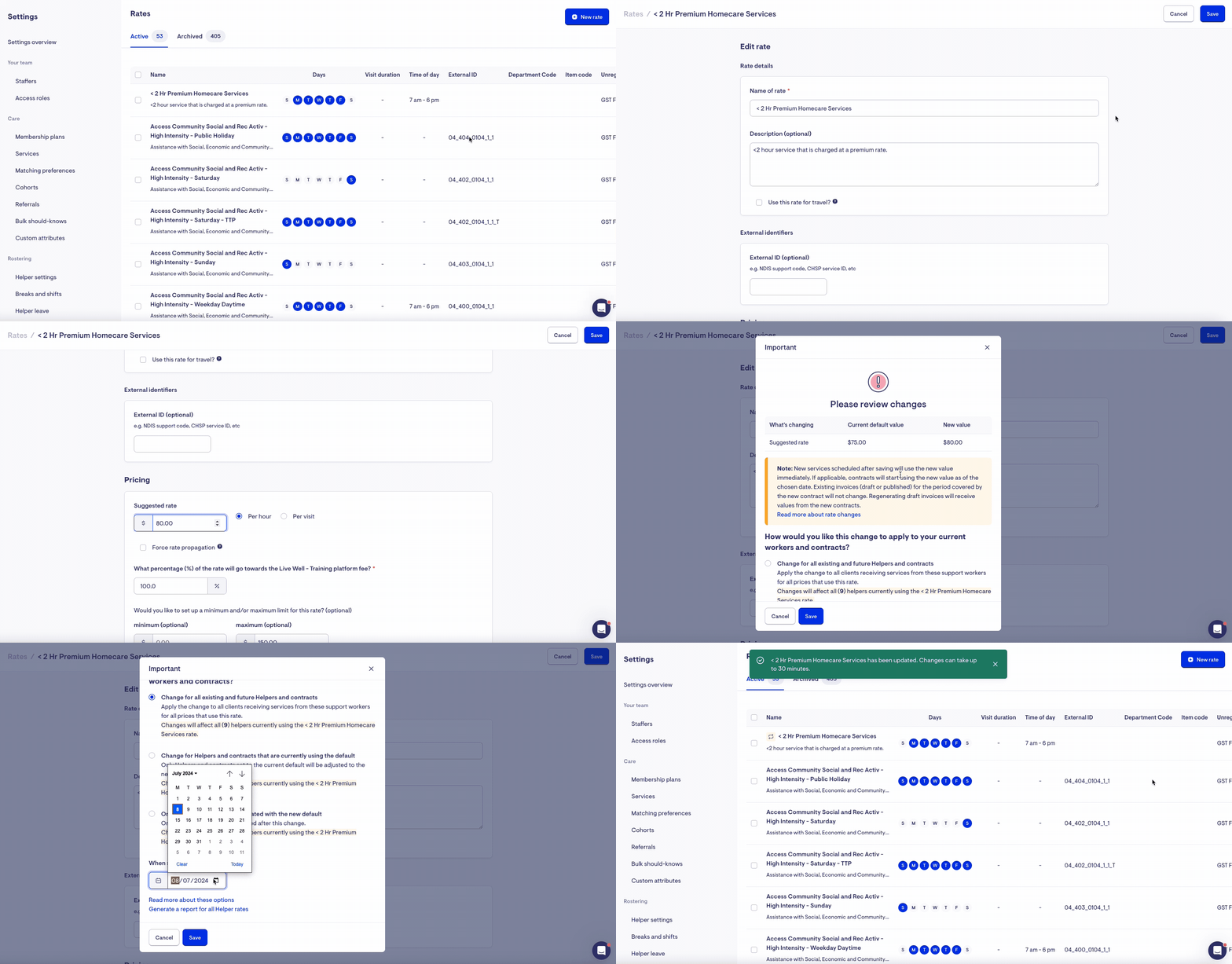
A new screen will load where you can make updates to the rate.
-
If you change the rate settings, the rate change review screen appears. This is where you choose which Helper and Member contracts should be updated, and set the effective date.
-
Update the suggested price and, if needed, backdate contracts. A summary of the previous and new rates is shown so you can confirm before saving.
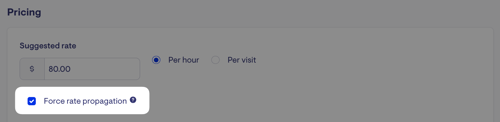
Top tip: The review screen only appears if you've actually changed something. If you click Save without making a change, nothing propagates. To update existing contracts (for example, changing start dates) without changing the rate itself, turn on Force rate propagation under the Pricing section before saving - this triggers the review screen so your date change can be applied.
Step 3: Understanding the Rate change review screen
There are three options for how a rate change can be applied:
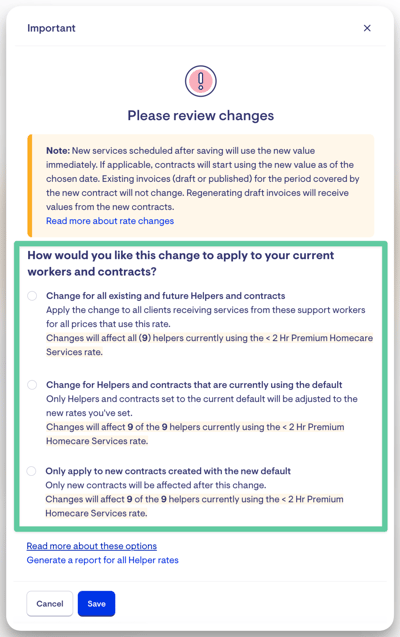
Option 1: Change for all existing and future Helpers and contracts
Applies the change to all clients receiving services from the affected support workers once propagated (which can take up to 30 minutes to reflect).
Under this option:
- A future-dated change only takes effect if there's an existing contract with the old product rate between the helper and the member. Until the scheduled date, the old rate remains in effect.
- If no such contract exists, the change applies immediately - and when a visit is scheduled, a new contract with the updated rate is created.
- Group Visit rates are updated automatically.
Option 2: Change for Helpers and contracts currently using the default
Applies the change only to helper–client contracts that use the previous default rate. Any helper or client with special or custom pricing for this visit rate is excluded.
Option 3: Only apply to new contracts created with the new default
Applies the change only to brand-new contracts or new helper–member relationships (where the helper has never provided services to that member before). It takes effect immediately, so any new contract created after propagation uses the new rate.
What Happens Next?
- A rate change can take up to 30 minutes to fully propagate and reflect across contracts.
- Scheduled (future-dated) changes only take effect on the effective date where an existing contract already includes the old product rate; until then, the old rate keeps applying.
- Where no matching contract exists, the change applies immediately, and new contracts are created with the new rate as visits are scheduled - even if the visit is scheduled before the effective date.
- Completed services that have already been invoiced are not affected. If the invoice is still in draft, you can update the billing run, or delete and regenerate it, to apply the change. If the invoice has been published, adjustments must be made using ad-hoc transactions or via Invoices & Credit notes.
- To make sure all new visits use the updated rate, we recommend backdating the change. For example, applying the new rate on 2 July with 1 July as the effective date. All completed and upcoming visits from the effective date onward will then use the new rate, as long as they haven't yet been invoiced.
Example
Harry Helper is already contracted to provide Domestic Assistance to Mary Member at $50/hour. This is the old rate. If a new rate of $60/hour is scheduled to take effect on 1 July, Mary’s visits will continue to be charged at the old $50/hour rate until 30 June, as expected.
However, if Harry is rostered to visit a new member, like Ivan, for the first time, the contract created for Ivan will automatically use the new $60/hour rate—even if the visit is scheduled before 1 July.
To ensure all new visits use the updated rate, we recommend backdating the rate change (e.g. apply the new rates on 2 July with 1 July as the effective date). This way, all completed and upcoming visits from the selected effective date onward will use the new rate—as long as they haven’t been invoiced yet.
Rate changes will not affect completed services that have been invoiced. If the invoice is in draft, you can update the billing run or delete and regenerate it to apply changes. Otherwise, adjustments must be made using ad-hoc transactions or Invoice & Credit notes if invoices have been published.
Troubleshooting
The rate change review screen didn't appear when I clicked Save.
This screen only appears when you've actually changed a rate setting. If you clicked Save without changing anything, nothing is propagated. If you're only adjusting contract dates (not the rate itself), turn on Force rate propagation under the Pricing section before saving — this brings up the review screen so your change can be applied.
My new rate applied to a visit that was delivered at the old rate.
This usually happens when a visit hasn't been invoiced yet, or when a new contract was created after the change. To keep everything from an earlier period on the old rate, backdate your change to the correct effective date, and make sure work from that period has been invoiced before you update the rate.
A purchase order or care management item picked up my new rate for an earlier period.
Rate changes are designed mainly for visits, but purchase orders and care management tracked time can also be affected. An open purchase order from a previous period will move to the new rate if it's touched after the update (for example, when a supplier invoice is matched or a line is edited), and un-billed care management time will pick up the new rate too. You may even see the old rate on the purchase order overview but the new rate when you open the individual line. To avoid this, finish and close off all billing for the period - including open purchase orders and un-billed care management time - before updating your rates, and align changes with the start or end of a billing period where possible.
My rate change hasn't shown up yet.
Propagation can take up to 30 minutes to reflect. If it still hasn't applied after that, check that you selected the right application option in the review screen (some options exclude custom or special pricing), and that a contract with the old rate actually exists for the affected helper and member.
I changed a rate but contracts with custom pricing didn't update.
That's expected under Option 2, which only updates contracts using the previous default rate. Any helper or client with special or custom pricing is deliberately left unchanged. Use Option 1 if you need the change to apply across all existing and future contracts.
Related: How do I update Provider travel and Client transport rates?
Provider travel and Client transport rates are kept separate from Visit rates because they work differently and use different units of measurement. See our dedicated article for more information.